Computing the HF absorption
Refractive index
Use of the Appleton-Hartree equation
The refractive index in the D-region may be computed by: [zawdie2017] [davies1990]
where
\(X = f_N^2/f^2\) represents the contribution of the electron density to the absorption
\(Y = f_{ecf}/f\) is the magnetic field term
\(Z_{ah} = \nu/(2\pi f)\) is the effect of collisions.
\(f_N\) is the plasma frequency
\(f_{ecf}\) is the electron cyclotron frequency
\(\theta\) is the angle between the magnetic field and the wave
The collision frequencies are found from Section Collision frequencies.
The plasma frequency
The plasma frequency only depend on the electron density. Since this is an attribute of the electrons class, the class instance is the only variable needed.
The electron cyclotron frequency
This frequency only depends on the magnetic field. To get the field, we use the IGRF 13 model (through the igrf Python library). From this model, we can recover in particular the magnetic field amplitude as well as the inclination. By convention, the inclination positive when the field is pointing downwards, so \(\theta\) is obtained by adding 90° to the inclination.
Computation of the absorption
From [davies1990], the absorption in the D-region may be found by:
where \(\kappa\) is the absorption coefficient. It is given by:
\(\mu\) is the real part of the refractive index (see below).
Once \(n\) is known, \(\kappa\) can be computed. Then, \(L_\alpha\) can be estimated. The computation of \(L_\alpha\) requires knowing the path of the wave. As a first approximation, we estimate that there are two cases:
The wave encounters an altitude in the D-region where \(f = fN\). It is reflected at that altitude, and \(L_\alpha\) will represent the absorption of the wave over its entire trajectory
The frequency of the wave is above the plasma frequencies in the D-region. Then, the wave crosses the entire D-region twice, and \(L_\alpha\) will be the absorption of the wave due to the D-region (which may be less than the total absorption if the wave is absorbed in the E or F regions).
Note
The absorption_coefficient() has an optional parameter, ignore_B. If this parameter is True, then we ignore the magnetic field term in the computation of the absorption.
Practice
The Appleton-Hartree equation is solved by the appleton_hartree(). Once this is computed, the absorption coefficients may be computed by the function absorption_coefficient(). Alternatively, the approximation used by [eccles2005] may be used instead through the absorption_coefficient_eccles() function.
The altitude reached by the wave is computed through the highest_altitude_wave(). This functions returns either the altitude of reflection or the highest altitude in the D-region.
Results
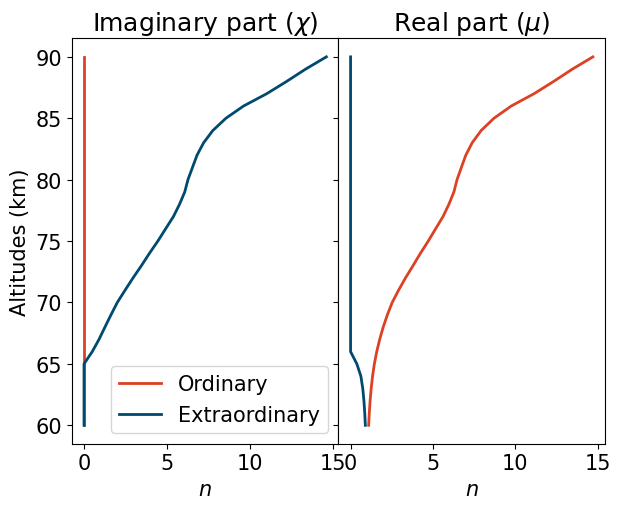
For a quiet time in November 2023 above Italy, the refractive index for a vertical wave is represented below.
Then, the absorption coefficient is computed as:
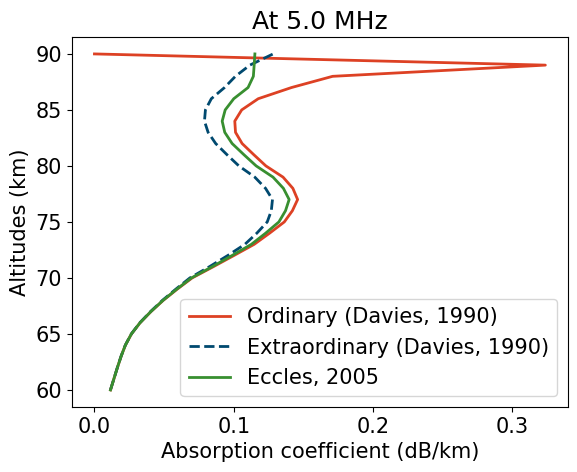
The total absorbtion \(L_\alpha\) is obtained by integrating over all D-region altitudes twice, as the wave goes up and down. It is aroung 44 dB at 5 MHz (consistent with Figure 1 of [zawdie2017] )