Ion chemistry in the D-region
Description of the model
Below is the scheme of the ions chemistry in the D-region presented in [mitra1972], [rowe1974] and [mitra1975]:
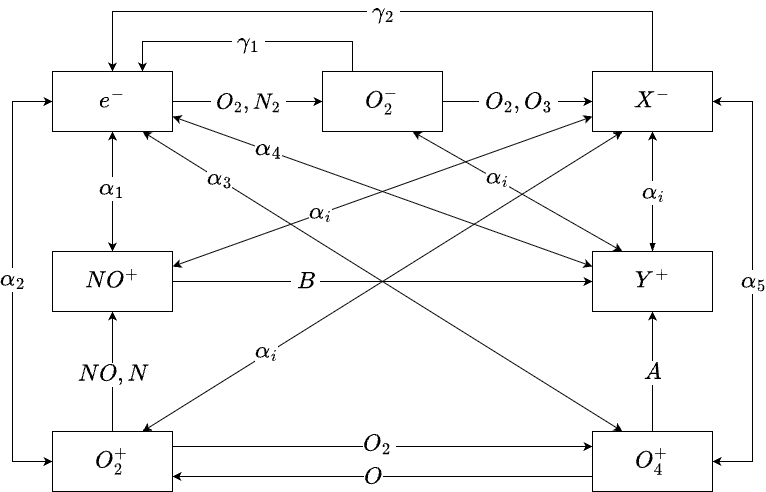
Each ion species is denoted by its chemical formula. \(Y^+\) represents cluster positive ions, while \(X^-\) denotes all negative ions with the exception of \(O_2^-\). The different reaction rates are presented in [mitra1972]. The coefficients \(Q\) represent the ionisation rate of the different species.
Assumptions
The electron and neutral temperatures are the same. This would be consistent with IRI outputs, and would be justified as there are many collisions in the D-region. This assumption is needed as we do not have measures or models of the electron temperature in the D-region. This is also a common assumption in D-region chemistry (e.g. [verronen2016] )
The neutral densities are considered to be sources of ions, but we assume the neutrals do not significantly vary. This is justified as those densities are much greater than charged particules, and they should only vary on longer timescales than the ones for solar flares.
Chemistry coefficients
All chemistry coefficients are computed from the compute_coefficients_mitra module. The table below present their values and the references. All coefficients not involving \(Y^+\) or \(X^-\) are taken from [pavlov2014], the other come from [mitra1975]. \(M\) is the sum of the \(O_2\) and \(N_2\) densities, and \(X = 300/Tn\). \(.^+\) represents any positive ion; \(.^-\) any negative ion.
Reactions |
Rate |
|---|---|
\(NO^+ \rightarrow Y^+\) |
\(1.31e-31 M^2\) |
\(.^+ \rightarrow .^-\) |
\(1e-7\) |
\(X^- \rightarrow e^-\) |
0.1 + \(4.0e-17 M\) [burns1991] |
\(O_2^- \rightarrow e^-\) |
See reactions 26, 27, 31, 33 and 34, Table 10 [pavlov2014] |
\(e^- \rightarrow O_2^-\) |
See reactions 1 and 2, Table 10 [pavlov2014] |
\(O_2^- \rightarrow X^-\) |
\(1e-30 O_2 \times M + 3e-10 O_3\) |
\(e^- + NO^+\) |
\(3.5e-7 X^{0.69}\) |
\(e^- + O_2^+\) |
\(1.95e-7 X^{0.7}\) |
\(e^- + O_4^+\) |
\(4.2e-6 X^{0.48}\) |
\(e^- + Y^+\) |
\(1e-5\) |
\(O_2^+ \rightarrow O_4^+\) |
\(4e-30 X^{2.93} M \times O_2\) |
\(O_4^+ \rightarrow O_2^+\) |
See reactions 37, 44 and 45, Table 6 [pavlov2014] |
\(O_4^+ \rightarrow Y^+\) |
\(1e-9 H_2O\) |
\(X^- + O_4^+\) |
\(1e-6\) |
\(O_2^+ \rightarrow NO^+\) |
\(4.1e-10 NO + 1e-10 N\) |