Photoionisation of neutral species
Ionisation by cosmic rays
To model the ionisation of the neutral species by cosmic rays, we use the approximation shown in [lehtinen2007]
with \(N\) the neutral density. \(N_p\) is the neutral density at the peak of the production, at altitude \(h_p\). \(q_p\) is the maximum value of \(q\). We take:
\(Q_p = 10 cm^{-3} s^{-1}\)
\(h_p = 15 km\)
Ionisation by solar flux
Once the absorbed fluxes are computed (see Absorption of the solar flux), the next step is to compute the number of ions/electron pairs produced. This is done through
where \(N\) is the number density of the neutral species being ionised, \(\sigma_i\) is the ionisation cross-section and \(\Phi\) is the absorbed flux. \(k_\lambda\) is the ionisation efficiency, given by [nicolet1960] and [bourdeau1966] . It is 45 for soft X-ray flux and 165 for hard X-rays, and represents the number of electron-ion pairs per photon in the solar flux.
We consider here that:
\(O_2\) is ionised by soft and hard X-rays to give \(O_2^+\)
\(O_2(^1 \Delta_g)\) is ionised by EUV and UV flux to give \(O_2^+\) ([pavlov2014], [paulsen1972])
\(N_2\) is ionised by soft and hard X-rays to give \(N_2^+\), which is immediately converted into \(0_2^+\)
\(NO\) is ionised by EUV fluxes to give \(NO^+\)
Important
The value of \(Q\) also has to be converted into particles/cm-3, which means converting \(\Phi\) by multiplying it by a factor \(\frac{\lambda}{2 \pi \hbar c}\). \(\lambda\) is the average wavelength here
All the cross sections are given in [pavlov2014] (Table 3) and its Erratum. The ionisation, absorption cross-sections and \(k_\lambda\) (see Photoionisation of neutral species) for hard X-rays are found in [siskind2022] . The only exception is the \(k_\lambda\) factor (\(pe/pi + 1\), with the notations in [siskind2022]) for the ionisation of \(O\) is 217.2 for the lowest HXR bin (it was not precised in the article, so we took the averaged value for [solomon2005] ).
Ionisation of \(O^+\) and \(N^+\)
In addition to the species mentioned above, the solar X-ray flux also ionises \(N_2\) and \(O_2\) to give \(O^+\) and \(N^+\). Those two species are not present in our ions scheme, but they contribute to the ionisation as they are converted into \(NO^+\) and \(O2^+\).
From the reactions rate reported in Table 6 of [pavlov2014] , the ratio of \(NO^+\) to \(O_2^+\) created can be determined. This is done in the conversion_OpNp() function. Those added contributions to the ion densities are recomputed from the solar X-ray flux at each time-step, similarly to any other ionisation source, for both \(N^+\) and \(O^+\).
Ionisation of \(O_2(^1 \Delta_g)\)
As mentioned above, this is done following [paulsen1972] . We use the formulation proposed by [swider1979] which explicitely involves H and Ch. Those two quantities are therefore computed once by the chapman() function and stored as an attribute of the radiation class.
In practice, this is done by calling the different functions of compute_ionisation (cibelow):
# Compute photon fluxes, using the taus already computed
Phi_SXR, Phi_HXR, Phi_EUV = ci.compute_photon_flux(rad_here)

# Compute ionisation of different species

# O+ from O2
ionisation_Op = ci.ion_O2_to_Op(Phi_SXR, Phi_HXR, rad_here, n_here)

# N2+ from N2
ionisation_N2p = ci.ion_N2_to_N2p(Phi_SXR, Phi_HXR, rad_here, n_here)

# N+ from N2
ionisation_Np = ci.ion_N2_to_Np(Phi_SXR, Phi_HXR, rad_here, n_here)

# NO+ from NO
ionisation_NOp = ci.ion_NO_to_NOp(Phi_EUV, rad_here, n_here)

# Cosmic-rays
ionisation_cr = ionisation_cr = ci.ion_from_cosmicrays(n_here, rad_here)
For a quiet day in winter above Italy (solar zenith angle : 58°), this gives:
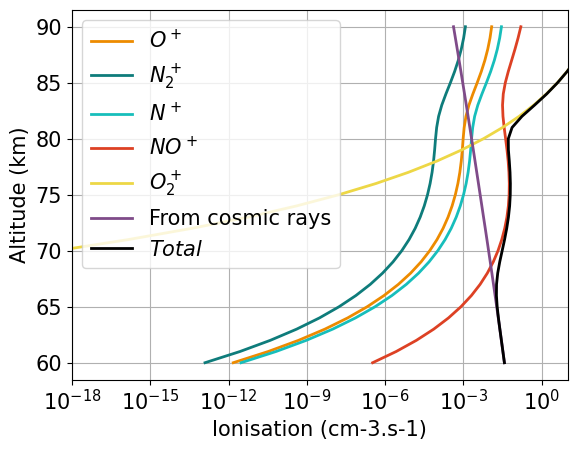
Important
We consider that all \(N_2^+\) are converted into \(O_2^+\) (e.g. [mitra1975] ).